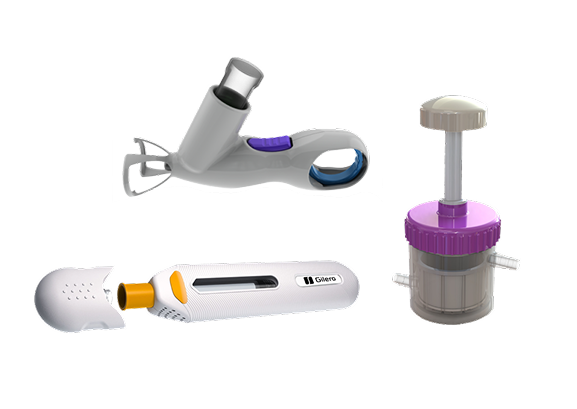


Requirements for moisture control in dry powder inhaler development and definition of desiccant packaging solutions.
Demand for inhaled therapeutics continues to grow steadily with estimates suggesting that the market for respiratory inhalers will reach a value of 41.4 billion USD by 2030[1]. Rising rates of respiratory illnesses such as asthma and chronic obstructive pulmonary disease are the primary driver of growth. Pressurized metered dose or dry powder inhalers (pMDIs or DPIs) are the ‘go to’ choice for treating these conditions. Hence, systemic drug delivery via the pulmonary route continues to attract considerable attention.
The high carbon footprint of pMDIs underlines an advantage of DPIs: drug delivery is patient- rather than propellant-driven, which has the additional benefit of coordinating dose delivery with patient inhalation[2]. Therapeutics for the treatment of respiratory illness dominate the DPI market with notable successes including Breztri® (Astra Zeneca), Respimat® (Boehringer Ingelheim) and Orbital™ (Aptar). However, achieving success with a DPI formulation, for either localized or systemic action, is far from straightforward. Advanced powder engineering techniques are routinely deployed to ensure necessary dose dispersion.
DPI development and specific challenges
To successfully reach the lower respiratory tract, active drug particles must be less than 5 µm in size; 1-5 µm tends to be the target range. Unfortunately, within this target range particles tend to be both cohesive and adhesive, with a marked tendency towards agglomeration. Developing an effective DPI that delivers particles of the required size, in the absence of any active device delivery mechanism, is therefore a substantial formulation and engineering challenge.
While carrier-free formulations are an option, a common strategy is to attach the fine active pharmaceutical ingredient (API) particles to larger carrier particles tens of microns in size. Lactose is a popular choice of carrier because it is well-tolerated by the lungs[3]. The API particles detach from the carrier during inhalation, which goes on to deposit predominantly in the oropharynx due to particle size[4]. With this approach, the carrier accounts for the bulk of the resulting formulation, making it easier to handle and to accurately dose the very small amounts of API required.
Formulators deploy a range of techniques to ensure dose dispersion and/or API detachment manipulating both the composition of the formulation and particle properties such as shape, surface morphology, and charge to achieve success. The particle engineering techniques deployed range from jet milling through spray drying and spray freeze drying to supercritical fluid technology, each associated with distinctly different physicochemical property development[5].
Testing early formulations in a prototype device is essential since product developers have the freedom to adapt both device and formulation characteristics to meet drug delivery goals. DPI delivery devices use complex internal geometries to translate the pressure drop induced by the inhaling patient into the energy needed for dose aerosolization, pressure drop across the device being a key differentiator for device design. Iterative development ultimately leads to a formulation device optimized for drug delivery to the lungs for a given API. Yet this is a complex, fine-tuning exercise[6].
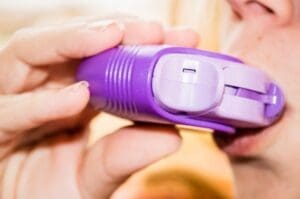
As a result, DPI products are relatively sensitive. They require protection from the external environment, notably from the ingress of moisture but also potentially from oxygen. The requirement is to ensure optimum shelf-life and reliable performance regardless of location. This requirement is also reflected in FDA guidance relating to stability, which indicates that testing should include both long-term storage at 25oC/60 percent relative humidity (RH) and at 30oC/65 percent RH for one-half of the proposed expiration dating period[7]. Understanding the impact of moisture on DPI effectiveness and taking steps to mitigate any potential deterioration is critical for successful product development and use.
Exploring the impact of moisture on DPI performance
The moisture level is widely recognized as playing an important role in powder behaviour and can have a significant impact on how a DPI formulation behaves, thereby compromising drug delivery. The low density, high porosity, and small size of many DPI formulation particles result in a relatively large specific surface area, making them susceptible to moisture adsorption and a corresponding change in physicochemical properties. Generally, higher moisture levels reduce the amount of drug that reaches the lungs by promoting agglomeration and compromising dose dispersion. However, there are a range of factors that influence the response to moisture of any given formulation, notably preparation method, and the potential for electrostatic effects5,6.
In terms of preparation technique, jet milling is a ubiquitous process across the pharmaceutical industry. It uses a highly compressed gas to force energetic high-speed collisions both between particles and with the vessel walls. These comminution processes tend to produce particles prone to high surface energy and electrostatic charge, with a relatively high concentration of amorphous content. On storage at high humidity, this content can crystalize, thereby promoting agglomeration5,[8]. Spray drying may similarly produce relatively hygroscopic, somewhat amorphous particles, notably for lactose-based formulations4. The optimal particle properties achieved through precise process control may therefore be readily compromised by sub-optimal moisture control.
Such inherent process-related tendencies can be reduced by, for example, relaxing particles under controlled conditions of temperature and humidity immediately after jet milling, by coating the resulting particles, and, in the case of spray drying, by co-spraying with a suitable excipient4,5. An alternative option is to select a preparation method such as supercritical fluid technology that tends to produce particles with greater crystallinity and fewer amorphous sites.
Preventing moisture ingress to the product is a primary focus. However, excessively dry conditions can also be problematic due to exacerbated electrostatic effects. DPI formulations can pick up electrostatic charge by triboelectrification during formulation preparation, product manufacture, and the aerosolization processes associated with product use, as particles undergo collisions between themselves and interactions with the surfaces of processing equipment or the product device. Highly charged particles may flow poorly, adhere to device surfaces, and/or fail to maintain content uniformity making the control of electrostatic charge essential for effective drug delivery[9].
Water is a highly effective conductor of electrical charge, which is why electrostatic charge is much less likely to accumulate under conditions of higher humidity. A relative humidity of 40% is routinely quoted as the cut-off figure above which sufficient moisture is present to effectively earth a product and minimize electrostatic effects. However, this is a generalized figure. Individual formulations, manufactured in different ways, differ with respect to the electrostatic charge they pick-up, typically via triboelectrification, their ability to discharge it, and in terms of the extent to which moisture levels can be elevated to tackle the issue, given other sensitivities to moisture.
In summary, the optimal environment for any given DPI with respect to moisture content is dependent on an array of physicochemical properties and may vary considerably from product to product. It is not always possible to prevent exposure to high or variable humidity, notably during product use. Yet moisture control that is well-matched to the product requirements can safeguard and optimize DPI performance during routine storage and use.
Ensuring effective moisture control
The best strategy for protecting any given DPI is dependent on the device involved. There are essentially three types of DPI: single dose, multi-unit dose, and multi-dose reservoir. With a single dose device, the patient inserts a capsule containing the formulation immediately prior to use. Multi-unit dose devices, in contrast, come preloaded with multiple doses held individually within compartments of a blister pack or cartridge, while in a multi-dose reservoir, formulation is metered from a single reservoir at the time of use3. Each type of product offers different opportunities for moisture control.
For example, capsules for single dose devices are commonly made of gelatine or hydroxypropyl methylcellulose (HPMC), which protect the formulation from moisture ingress. HPMC capsules, which have a moisture content of between 4.5 and 6.5% at 35-55% RH, are particularly effective, offering excellent protection against moisture ingress and robust puncturing performance across a range of relative humidities. They may be the preference for hygroscopic products[10],[11]. Gelatine capsules, in contrast, pick up water more easily, reaching a moisture content of between 10-16% at 35-55% RH.
Primary packaging offers a clear opportunity for moisture control within inhaler packaging to control moisture level, and in some cases, to additionally address the secondary issue of oxygen ingress[12]. Placing drop-in desiccants such as desiccant sachets into the aluminium packaging pouch in which the DPI is supplied is also common practice to safeguard inhaler performance prior to initial use by the patient.
The preceding strategies are analogous to those used for oral solid dosage products using drop-in desiccants. DPIs, however, present the additional opportunity to fit desiccant into the device itself. The range of suitable, commercially available desiccants for DPIs extends to silica gel, molecular sieves, activated clay, calcium oxide, calcium sulphate, and zeolites. More rarely, a humectant may be used, i.e. a modified desiccant that can both absorb or release moisture, thereby enabling the maintenance of specified relative humidity, which is a highly desirable characteristic for DPIs. In either case the desiccant or humectant must, of course, be arranged within the device to prevent any possible contact with the drug.
By deploying the right desiccant technology, in one or more of these ways, DPI manufacturers can safeguard product stability and prolong shelf-life while at the same time helping to ensure consistent performance over the lifetime of the product.
Supporting DPI development
Controlling the moisture level in a DPI is crucial as it can significantly affect the drug delivery performance of the formulation. The preceding sections make a clear case for determining a target level for moisture control on a product-by-product basis for DPIs and underline the value of considering moisture control strategies at an early stage when the detailed design of the device is still in play. Effective moisture management requires technical know-how of desiccants and related packaging solutions that can be applied from the very beginning of the device development process.
This is where Sanner can support. As a contract development and manufacturing organization (CDMO) for drug delivery devices and leading supplier of pharmaceutical desiccant packaging solutions, Sanner is in a unique position to support inhaler and in particular DPI developers. Sanner has in-depth understanding of the issues, extensive in-house capabilities for the conceptualization and development of drug-delivery devices, clean room manufacturing capacity, and established capabilities and solutions for moisture control. Close collaboration from the outset is the key to capitalizing on these attributes and ensuring that DPI delivery device and packaging are optimal for the given application.
Written by Chris Gilmour, Director of Sales, Sanner of America and featured in On Drug Delivery
References:
[1] Market Research Future ‘Respiratory Inhalers Market Research Report Information By Type (Manually Operated and Digitally Operated), By Product (Dry Powder Inhaler, Metered Dose Inhaler and Others), By Application (Asthma, COPD and Other), By End User (Hospitals & Clinics and Respiratory Care Center) and By Region (North America, Europe, Asia Pacific and rest of the World) – Forecast Till 2032’, February 2021
[2] M Urrutia-Pereira et al ‘Environmental impact of inhaler devices on respiratory care: a narrative review’, J Bras Pneumol. November 2025; 48(6): e20220270
[3] N. Alhajj et al ‘Designing enhanced spray dried particles for inhalation: A review of the impact of excipients and processing parameters on particle properties’, Powder Technology Vol 384, May 2021, pp 313-331
[4] N. Shetty et al ‘Physical stability of dry powder inhaler formulations’ Expert Opin Drug Deli, December 13, 2019 ;17(1):77-96
[5] B. Chaurasiya and Y-Y Zhao ’Dry Powder for Pulmonary Delivery: A Comprehensive Review’. December 28, 2020;13(1):31
[6] S. Dhoble et al ‘Design, development and technical considerations for dry powder inhaler devices’, Drug Discovery Today Vol 29, Issue 5, May 2024, 103954
[7] FDA Draft Guidance ‘Metered Dose Inhaler (MDI) and Dry Powder Inhaler (DPI) Products – Quality Considerations, Guidance for Industry’, April 2018
[8] C. Moura et al ‘Impact of jet-milling and wet-polishing size reduction technologies on inhalation API particle properties’, Powder Technology. Vol 298, September 2016, pp 90-98
[9] M. W. Jetzer and B.D. Morrical ‘Investigation of Electrostatic Behavior of Dry Powder-Inhaled Model Formulations’ J. Pharmaceutical Sciences Vol 108, Issue 9, September 2019, p 2949-2963
[10] B. E. Jones ‘The Evolution of DPI Capsules’ Inhalation, January 2008
[11] A. S. Barham ‘Moisture diffusion and permeability characteristics of hydroxypropyl methylcellulose and hard gelatin capsules’, Int J Pharm, January 30, 2015;478(2):796-803
[12] C.Aubrey ‘Choosing between capsules and blisters’, Inhalation, December 2011